





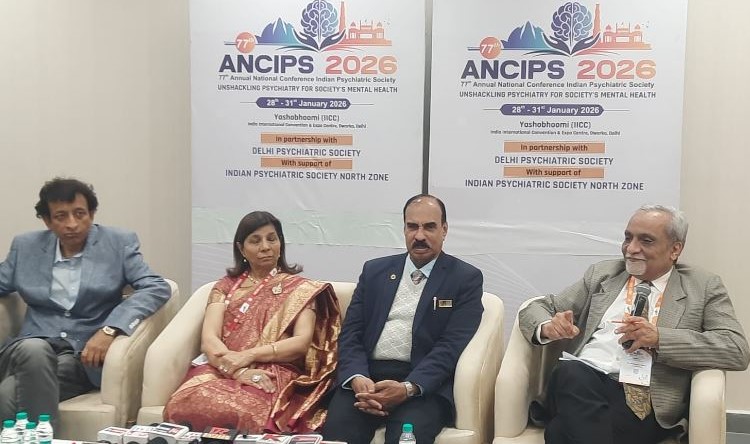
New Delhi: Lack of awareness about timely treatment is fuelling a rising mental health crisis among young Indians, health experts warned on Wednesday at the 77th Annual National Conference of the Indian Psychiatric Society (ANCIPS 2026). Speaking at the four-day event at Yashobhoomi, psychiatrists, researchers, and policymakers highlighted that nearly 60 per cent of mental disorders are diagnosed in individuals under 35, underscoring how early these illnesses are manifesting.
Data presented at the conference revealed that the median age of onset for most mental illnesses is between 19 and 20 years. Global and Indian studies, including a large-scale international study published in Molecular Psychiatry tracking over seven lakh individuals, show that 34.6 per cent of mental disorders begin before age 14, 48.4 per cent before 18, and 62.5 per cent by 25. By this age, attention deficit hyperactivity disorder (ADHD), anxiety, and eating disorders have usually emerged, while depression, substance use disorders, and behavioral addictions are appearing earlier than in previous decades.
Experts cautioned that when mental disorders start young and go untreated, they often become chronic, leading to long-term disability and significant social and economic consequences. “When 60 per cent of mental disorders are affecting people below 35 years of age, it becomes clear that India’s mental health crisis is unfolding far earlier than we once believed. These are the years when individuals are studying, building careers, and contributing to society,” said Dr. Deepak Raheja, Organising Secretary of ANCIPS Delhi.
Excessive use of digital devices, dependency on virtual interactions, academic pressure, unemployment, social isolation, and unresolved emotional stress were cited as key drivers of the crisis. Experts also noted that the COVID-19 pandemic, economic uncertainty, and changing social structures have intensified anxiety, depression, and psychological distress among young adults, with recent data indicating a 101.7 per cent increase in frequent mental distress among those aged 18 to 25 between 2011 and 2021.
“One of the main reasons for rising cases in India is the lack of awareness about timely treatment. If reported early, almost all mental disorders can be treated successfully, allowing patients to lead normal lives,” added Dr. Nimesh G. Desai, former Director of the Institute of Human Behaviour & Allied Sciences (IHBAS). He stressed that early-onset mental disorders, if ignored, affect not just individuals, but families, workplaces, and the country’s overall productivity. “Psychiatry in India must shift from a reactive approach to a preventive and early-intervention-driven model,” he said.
Dr. Savita Malhotra, President of the Indian Psychiatric Society, highlighted how rapid social change has reshaped young people’s experiences. “Today’s youth are navigating intense academic competition, constant digital comparison, loneliness despite connectivity, and uncertainty about employment and relationships. Mental health services must adapt to these realities and become more accessible, youth-friendly, and stigma-free,” she said.
Experts emphasised that early identification, school- and college-based mental health programmes, and destigmatisation are no longer optional—they are essential to protect India’s demographic and economic future. Suicide data discussed at the conference added urgency, with the World Health Organization ranking suicide as the third leading cause of death among 15- to 29-year-olds.
The conference also addressed India’s wide mental health treatment gap, estimating that 70 to 80 per cent of people with mental disorders still do not receive timely or adequate care. Through policy discussions and scientific sessions, the Indian Psychiatric Society called for stronger policies, increased funding, workforce expansion, and nationwide awareness initiatives, particularly for children, adolescents, and young adults. Experts concluded with a warning: ignoring early-onset mental disorders carries social, economic, and human costs India can no longer afford.