






It is not just a renewed conflict between the greedy stupid Pakistani generals and the Taliban regime, which adheres to the ideals of Islam than exploiting the faith for power to serve the geopolitics of the West.
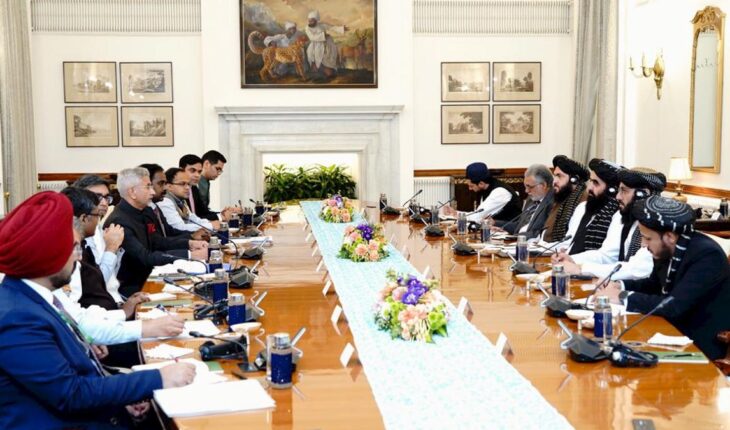
Many in India consider the recent visit of Amir Khan Muttaq, the foreign affairs minister of Afghanistan, in India as a historic, and perhaps, game changer of the power-play in the region.
It may be unfair to expect that the visit would really undo the two centuries of the colonial agenda of manipulating Muslims of India, but it is expected to trigger a formidable challenge to the ongoing communal and Islamist politics under the Western umbrella of nearly eight decades.
The visit of Muttaq to Deoband in Saharanpur,UP, perhaps, has reignited the hope that the deliberate mischief of the colonial era could now be really corrected. Further, it might further stress on the reaffirmation of the legitimate historical role of Muslims in the Indian subcontinent.
Trojan Horse
It cannot be denied that before 1947, when India was partitioned, the British intelligence and its universities had successfully woven communal narratives alienating the Muslim from the central political scene of the Indian subcontinent. In other words, the visit of Mutaq to Deoband might trigger the much awaited recalibration of Indian Islam, a victim of the colonial conspiracy. The central role to the Muslims was finally ended with the exile of the last Mughal emperor, Bahadur Shah Zafar in 1858.
A few decades later his death in Bumrah now Myanmar was not even mourned in India.
In this British conspiracy, the role of the Muslim clergy as a Trojan horse of the British in India has been detailed in the confidential documents.
Later, after the World War l-2 at the Potsdam talks, the then British Prime Minister, Winston Churchill, had convinced the then US President D.Roosevelt, that how Pakistan would be serving the colonial interests. Thus, the new edition of the great game in the region was envisaged.
It is difficult to foresee whether the Muslim clergy, who were being bribed for more than a century to speak against Hindus, Sikhs and Russians after the Friday prayers could be really reoriented. The recent visit of the Afghan minister should be considered just a beginning towards correcting the false narratives.
Durand Line
With the expiry of the 100-year old border agreement with British India, there is now no defined border between Afghanistan and Pakistan, a country carved out in 1947. The border agreement was signed in 1893 to be revalidated in 1993.. It is imperative on Pakistan, the successor state of India in the region, to renew the border agreement, while reuniting the Pashtun population, but even after the three decades of its expiration, the hybrid government in Islamabad dominated by the uniform did not care to resolve the sensitive border issues between the 2640 kilometers border line between the two countries. Instead, Islamabad has resorted to unleashing violence against the Pashtuns, living on the borders.
It may be noted that the Durand Line named after Sir Henry Mortimer Durand was imposed on the then Afghan ruler, Amir Abdul Rahaman Khan.
The visit of Mutaq to the Deoband seminary is expected to reignite the scholars of this institution, who have always been opposed to the partition of India.
On the other hand, it may be recalled that the Barelvi movement, believed to be liberally funded by the British, supported the two-nation theory. The Islamic Sunni cult
was founded by Ahmed Raza Khan Barelvi to counter other reformist traditions, especially the Deobandi movement. The Barelvis had supported India’s partition along with Ahmadiass and Shia Muslims.
In fact, the concept of pure Islam was deliberately confused by the Muslim clergy in recent years. Many confused writers consider the terms “Wahhabi” and “Deobandi” the same and often consider them interchangeably, perhaps,
due to similarities in their revivalist approach and the perceived opposition of both to popular religious practices associated with Sufism and other traditional Sunni schools.
Indian Concerns
It is hoped in New Delhi that the India-Afghanistan ties will grow stronger in future, especially after the visit of Mutaq to Darul Uloom Deoband in Saharanpur, one of the most influential Islamic seminaries in South Asia.
It may also correct the initial mischief of the British and later endorsed by the American establishment. It is also necessary that India should campaign that with the Chinese ascendancy in the region, the US has a limited role in the region, which has been the centre of conflicts for centuries.
Gopal Misra has been associated with national and international media. His books on journalism and geo-politics have been well-appreciated. Views are personal.