






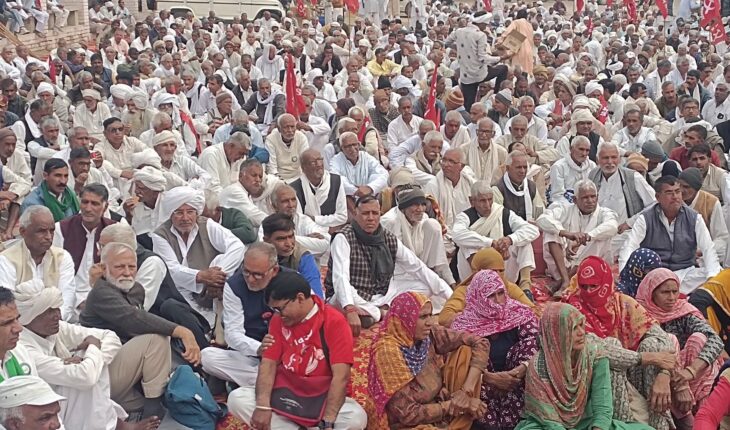
The Indian farmers’ unions are once again girding up their loins, but why? Why do they term the Seeds Bill -2025 a corporate charter disguised as reform, and not a farmers’ law? Why does the Electricity Bill 2025 irritate the farmers’ unions? Why do they think that this Bill will reduce the states as mere spectators and create a central—controlled Electricity Council? Let us analyse.
The unions allege that the Government of India (GOI) is hammering the interests of the farmers through newly drafted bills- Electricity Bill 2025, VB GRAMG Act 2025, Seeds Bill 2025, and 4 Labour Codes, and so they are demanding repeal of all these bills.
Here we will discuss the Two Major Bills affecting the farmers the most — Electricity Bill 2025 and the Seeds Bill. All India Kisan Sabha (AIKS) has critically analysed these bills.
Seeds Bill-2025: The Government of India has proposed to replace the old Seeds Act (1966) with the modernised Seed Bill -2025 arguing it wants to regulate seed quality, registration, labelling and compensation for poor-quality seeds.
But AIKS reacts that the Seeds Bill -2025 is a corporate charter disguised as reform, and not a farmers’ law. Pushed as “modernisation”, it actually centralises and weakens farmers’ agency. It will open the seed sector to deepen corporate capture, risking India’s seed sovereignty. It is designed for ease of doing business, not ease of surviving as a farmer.
Now the question arises—’Who will get benefits? AIKS comments— ‘Multinational seed giants already dominate a market worth $ 3.82 billion. The Bill expands their control, ensures price freedom, and weakens oversight. Though heavy penalties exist, but no guaranteed compensation when seeds fail. Corporates profits will rise, while farmers will have to shoulder all risks and losses.
What does Bill leave out deliberately? There is no statutory, time-bound compensation for crop failure in the Bill. It pushes farmers back to slow, costly consumer courts. A ‘good faith’ clause protects corporates, and not farmers. No strong support for community seed banks or PPVFR protections. (Protection of Plant Varieties and Farmers’ Rights).
The farmers’ union fears that this will result in -‘Risky Seed, and Weak Safeguards’. Because the Bill allows reliance on foreign certification and imported trial data, but ignores India’s diverse Agro-climate needs. It opens pathways for unproven GM seeds without proper accountability. NO wonder, scientists are calling it – “Facilitation, Not Regulation”.
Electricity (Amendment) Bill -2025: Farmers union- AIKS analyse that under the provisions of this new Bill, private DISCOMs will be allowed to use government-built lines for cheap, cherry-pick rich consumers, and walk away with profit. This will push public DISCOMs into collapse, while blaming them for the ‘losses’ by World Bank- style policies. The Bill ends a decade-old system where big consumers helped subsidise poorer households. Now it is proposed to have the same tariff, whether one switches on a single bulb or has a luxury hoarding. Electricity usage bills will now be set strictly on- ‘Cost to Service’—meaning steep hikes for ordinary farm class.
This Bill will reduce the states as mere spectators and create a central—controlled Electricity Council. Part of this– “One Nation, One Policy” will push uniform control over state electricity decisions. If this Bill gets implemented as an Act, the states will have to pay subsidies in advance, but this is unrealistic given their current finances. If states fail, then subsidies will vanish, bills will rise, and distress will deepen.
It reintroduces what mass protests defeated earlier, now with more draconian clauses.
Why do the farmers’ unions term this Bill as a threat to farmers and vulnerable consumers?
AIKS states that free /subsidised power for farmers, Dalits, Tribals, aquaculture and more will become uncertain. This Bill is structurally next to push corporate profits over farmers’ interests. Therefore, the Farmers unions are demanding its withdrawal, and are planning to protest across the country to force the GOI to repeal these draconian Bills.
An umbrella of all major farmers’ unions, Samyukta Kisan Morcha’s (SKM) National Council meeting held on January 11,2026, at HKS Surjeet Bhawan, New Delhi adopted a resolution warning the NDA Government against signing a Free Trade Agreement with the USA to open agriculture and dairy sectors. The resolution called upon the farmers and the people in general to rally against compromising the interests of the country under the pressure of US Imperialism and the corporate forces and declared farmers will unleash widespread and militant struggles larger than the 2020-21 historical farmers’ struggle.
The meeting called upon farmers and workers to organise immediate militant protest actions across India if the NDA Government enact the Electricity Bill 2025 in the forthcoming Budget session of the Parliament.
A press statement of SKM reveals that the meeting decided to ensure massive participation of farmers on 16 January, All India Resistance Day protest actions including district level demonstrations, block/village level public meeting and New Year’s pledge of “build continuous, united pan-India struggle till victory” on the demands of repeal the Electricity Bill 2025, the VB GRAMG Act 2025, the Seeds Bill and 4 Labour Codes.
The demand charter includes the long-term demands of enact laws for MSP@C2+50% for all crops with guaranteed procurement, comprehensive loan waiver to liberate farmers from indebtedness and end peasant suicides, implement LARR Act 2013 and protect the federal rights of the states by restoring the taxation power by amending the GST Act and provide 60% share of divisive pool (including the revenue through cess and surcharge) instead of the current share of 31%.
The meeting also decided to observe 26 January 2026, the Republic Day in support of all the above-mentioned demands and to endorse the constitutional rights of freedom of expression, right to protest and repeal authoritarian laws including UAPA. A resolution on democratic rights urged the NDA Government to immediately release all in prison including Sonam Wangchuk of Ladakh and those remains in jails without trials even after five years. The state leadership will work out the protest “People’s March” in the afternoon without affecting the official Republic parade and in coordination with the workers and agricultural, rural workers and organise tractor parade, vehicle rally, motorcycle rally and mass demonstrations.
The meeting endorsed the call of General Strike on 12th February 2026 demanding repeal of 4 Labour Codes and called upon farmers to come out on street and organise massive demonstrations on that day and the details will be worked out in the respective states. The meeting declared unconditional support for the workers and resolved to fight till the demands are achieved.
The meeting urged all the member organisations and all the state coordination committees of SKM to organise widespread struggles and campaigns at the block and village level explaining the series of corporate attacks on the working people and prepare for a long haul of massive pan India struggles with determination. The next national Council meeting will be held on 24th February in Haryana and will resolve to undertake a concrete plan of actions if the NDA Government is not ready to start discussion with the leadership of the workers, farmers and agricultural and rural workers on the genuine demands.
Jag Mohan Thaken is a Senior Journalist, Columnist & Political Analyst, views are personal