






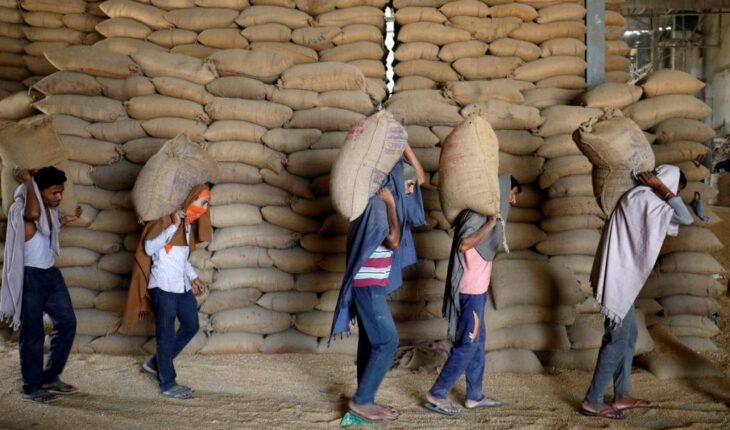
Decision aims to stabilise domestic markets, prevent distress sales, and ensure better returns for farmers
Chandigarh: Expecting a bumper wheat harvest this year the union government has approved the export of 25 lakh metric tonnes (LMT) of wheat along with an additional 5 LMT of wheat products, citing comfortable domestic stocks and a favourable production outlook.
The move is designed to stabilise domestic markets, prevent distress sales during peak arrivals, and ensure remunerative prices for farmers without compromising food security.
According to official data, wheat stock availability with private entities during 2025–26 stands at around 75 LMT, nearly 32 LMT higher than the corresponding period last year. In addition, wheat stocks in the central pool with the Food Corporation of India are projected to reach approximately 182 LMT as of April 1 2026, indicating a comfortable supply position.
Wheat acreage during the ongoing Rabi 2026 season has also expanded to 334.17 lakh hectares, compared to 328.04 lakh hectares last year. The higher sowing area, backed by assured Minimum Support Price (MSP) procurement, signals expectations of another robust harvest.
Officials said the calibrated export decision follows a comprehensive review of stock levels, price trends, and production prospects. With domestic prices softening amid abundant supply, allowing exports is expected to improve market liquidity and support farm incomes.
India had imposed restrictions on wheat exports in May 2022 after an unexpected heatwave reduced crop yields and triggered a sharp rise in domestic prices. The decision was taken to safeguard food security and control inflation amid global supply disruptions following the Russia-Ukraine conflict.
Since then, exports were either banned or tightly regulated through government-to-government arrangements. The current decision marks a shift from restriction to calibrated liberalisation, reflecting improved domestic availability and production prospects.
Additional 5 LMT Sugar Exports Approved– Alongside wheat, the government has approved the export of an additional 5 LMT of sugar during the ongoing Sugar Season 2025–26.
Earlier, on November 14, 2025, the government had permitted sugar mills to export 15 LMT. However, as per industry data, only 1.97 LMT had been exported as of January 31, 2026, while 2.72 LMT had been contracted for export.
The newly approved 5 LMT will be allocated to willing sugar mills on a pro-rata basis, subject to the condition that at least 70% of their allocated quota is exported by June 30, 2026. Mills must indicate their willingness within 15 days of the order’s issuance, and allocated quotas cannot be swapped or transferred.
India — the world’s second-largest sugar producer after Brazil — has periodically regulated sugar exports to manage domestic supply and price stability. Export curbs were tightened during 2022–23 and 2023–24 due to concerns over lower output caused by erratic monsoons in key producing states like Maharashtra and Karnataka, rising domestic consumption, and the need to prioritise ethanol blending under the national biofuel programme.
With improved production outlook and manageable domestic availability in 2025–26, the government has now moved to gradually ease restrictions.
Balancing Farmer Income and Food Security- The twin decisions on wheat and sugar exports reflect the government’s strategy of calibrated trade management — tightening exports during shortages to control inflation and easing them during surplus years to support farmer incomes and prevent market gluts.
Officials emphasised that the current export approvals are based on strong stock positions and are structured to ensure that national food security remains fully protected while providing market opportunities for producers.