






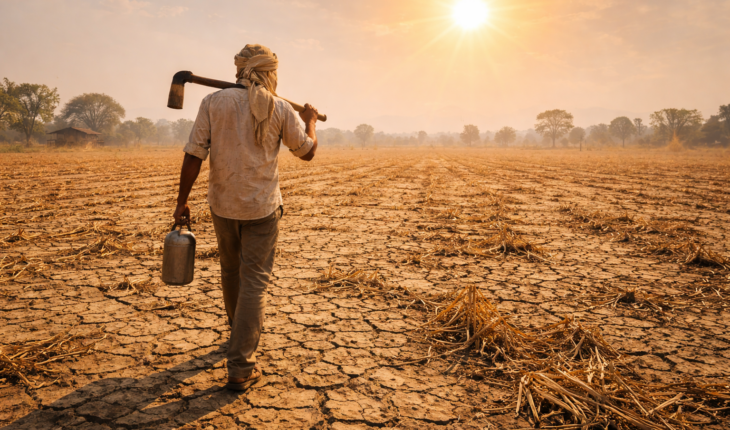
New Delhi: India may be heading toward a dangerous summer as heatwaves arrive weeks early — even in a year that should have been cooler.
Despite the cooling influence of La Niña, temperatures have surged across several parts of the country far earlier than usual, raising alarm among scientists that climate change is increasingly overpowering natural climate cycles. The warning signs are already visible. Mumbai touched 40°C in early March, nearly 7.6°C above normal, while Delhi-NCR temperatures are running 5–7°C above seasonal averages, indicating an unusually early surge of heat.
An analysis by Climate Trends, which examined temperature patterns, rainfall trends and seasonal transitions across the country, says the shift reflects a deeper transformation in India’s climate — shorter winters, a disappearing spring season and increasingly longer, hotter summers.
Heatwaves weeks ahead of schedule
Extreme heat has already begun appearing across multiple regions weeks before the typical onset of summer. Even Himachal Pradesh, which normally remains relatively cool at this time of year, has reported heatwave to severe heatwave conditions, with temperatures 5–8°C above normal. Parts of Vidarbha in Maharashtra are also witnessing heatwave-like conditions weeks ahead of schedule, highlighting how rapidly temperatures are rising across the country.
According to Mahesh Palawat, Vice President – Meteorology and Climate Change at Skymet Weather, the early surge in temperatures is unlikely to ease soon. “We do not see any immediate respite from the rising heat. Heatwave conditions are expected to expand further across Maharashtra, Rajasthan and Gujarat,” he said.
Winter collapses despite multiple western disturbances
The early heat has followed an exceptionally weak winter rainfall season. February recorded an 81% rainfall deficit, with the country receiving just 4.2 mm of rainfall against the normal 22.7 mm. The deficit is particularly striking because nine western disturbances passed across north India during the period — nearly double the usual number — yet most were too weak to produce meaningful precipitation.
Scientists say the lack of winter rainfall has accelerated soil drying and surface heating, allowing temperatures to rise rapidly as the country moves toward summer.
The result is a shrinking winter and an almost absent spring season, compressing India’s traditional seasonal cycle into shorter winters and longer, more dangerous summers.
La Niña losing its cooling grip
The development is especially concerning because it is unfolding during a La Niña phase, which typically lowers global temperatures and moderates heat across many regions.
Yet 2025 still emerged as the eighth warmest year in India since 1901, with the country’s average land surface air temperature 0.28°C above the 1991–2020 average, according to the analysis.
Scientists say the cooling influence of La Niña is no longer strong enough to offset the warming caused by climate change, highlighting how rapidly global temperatures are rising.
Natural climate variability is now interacting with long-term warming trends in ways that are altering India’s seasonal weather patterns, as per the report.
Rising heat stress risks
Experts also warn that higher temperatures combined with increasing humidity are pushing wet-bulb temperatures closer to dangerous levels, particularly in coastal and densely populated urban regions. High wet-bulb temperatures limit the body’s ability to cool itself through sweating, increasing the risk of heat exhaustion, heatstroke and other heat-related illnesses.
Even when temperatures remain below official heatwave thresholds, high humidity can make conditions dangerously oppressive, meteorologists say.
Warning for the months ahead
The India Meteorological Department has already projected above-normal heatwave days across most parts of the country between March and May.
Scientists say the unusually early heat this year could be the first signal of a longer and more intense summer, as rising global temperatures continue to reshape India’s seasonal weather cycle.
The emerging pattern suggests that India’s traditional sequence of winter, spring and summer is increasingly collapsing into a shorter winter followed by a longer and far more dangerous summer.