





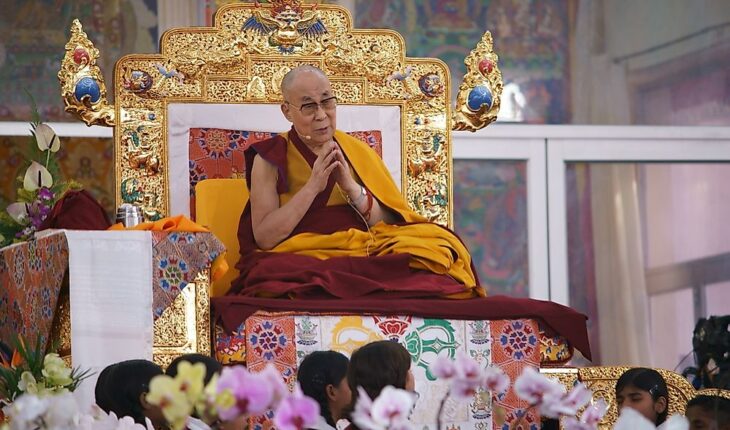
Amidst the reports of the ‘mysterious’ disappearance of the Chinese autocrat, President Xi Jinping, in the media for the past several weeks, the Dalai Lama, celebrates his 90th birthday on Sunday, July 6, announcing the procedure of the incarnation of his successor. It has reinvigorated the yearning of freedom among the Tibetans worldwide, thus challenging the Dragon’s conspiracy to consign the thousand-year tradition of the Dalai Lama to history.
In recent decades, especially under the presidency of Joe Biden, the USA had almost conceded to Beijing’s imperial designs. During his tenure as the vice-president, Biden had participated in a meeting with Xi Jinping in Tibet, thus finally conceding Tibet’s enslavement to Beijing. However, just a few days before his birthday, the Dalai Lama was felicitated by top Buddhist monks at the headquarters of his government in exile at Dharamshala in Himachal, where he had announced that the institution of the Dalai Lama would continue even after his death. It was accompanied by the statement of an Indian minister endorsing and respecting the decision of His Holiness.
It is not surprising that a section of foreign affairs scholars in New Delhi interpret the announcement of the Dalai Lama regarding his succession and its Indian endorsement in the context of the US President Donald Trump’s return to power. Earlier, at the Shanghai Cooperation Organization (SCO) conference held on June 26 this year, Indian Defence Minister, Rajnath Singh, had refused to sign the joint statement because it did not mention the Pahalgam attack but included militant activities in Balochistan. In Balochistan, the people are demanding independence from Pakistan, where thousands of youths disappeared, believed to be killed by the Pakistani army for opposing the illegal mining of precious metals and other rare earth materials with the connivance of the Chinese companies.
It appears that with the recent support of Washington, India could take a clear and strong stand on the issues, especially those which are uncomfortable to Beijing. Without naming China, the Union Minister, Kiren Rijiju, has recently stated that “The Dalai Lama is the most important and defining institution for Buddhists, all those who follow the Dalai Lama feel that the incarnation is to be decided by the established convention and as wish of the Dalai Lama himself. Nobody else has the right to decide it except him and the convention in place”. It appears that inspired by Trump’s aggressive China policy, the Tibetans in exile as well as in Lhasa have become a little hopeful of getting their existence as human beings in their homeland.
There are hundreds of Tibetans who are keen to facilitate their spiritual leader at Dharamshala, including about two dozen of them who had dared to cross to Nepal. They were arrested, but the timely intervention of the Nepalese Supreme Court has halted their forced deportation at least for a while.
The Conference and Repression
Earlier, the 15th Tibetan Religious Conference was held between July 2 to 4, 2025, which was attended by several highly respected lamas of Tibetan Buddhism and the Bon tradition, as well as the leadership of the Central Tibetan Administration and the secretaries of the Office of His Holiness the Dalai Lama. It was attended by a total of 115 lamas, tulkus, and monastery representatives. Much to the discomfiture of Beijing, the Dalai Lama also spelt out the succession procedure to be followed by his death in this conference.
Meanwhile, there are reports that the recent developments have displeased the Chinese government. It has unleashed the repression of Tibetans, but details are to come yet. According to a western media report that its representative had visited the Kirti monastery in China’s south-western Sichuan province earlier this week, the situation is quite grim for the Tibetans. He had been at the centre of Tibetan resistance for decades just two days before the Dalai Lama’s birthday.
It may be recalled that about two decades ago, a number of Tibetans had set themselves on fire. Instead of allowing them any freedom, Beijing set up a police station inside the main entrance of the monastery. In their bid to keep the innocent Tibetans under control, a web of surveillance cameras on thick steel poles surround the compound, scanning every corner. A monk cautioned the media person that “They do not have a good heart; everyone can see it,” the monk adds. Then comes a warning. “Be careful, people are watching you.”
In spite of the threat to his life and freedom, the monk confided in him that the men tailing them were the volunteers of the Communist Party of China. They have occupied Tibet for 75 years, ever since it annexed the region in 1950. Beijing has branded the Dalai Lama as a separatist, and those who display his image or offer him public support were jailed even without any trial.
In 2008, protests erupted during the Tibet-wide uprising; according to some accounts, a monk held up a photo of the Dalai Lama inside the Kirti monastery. It eventually escalated into a riot and Chinese troops opened fire. At least 18 Tibetans. There have been frequent reports of violent clashes between Tibetans and the Chinese paramilitary. Beijing claims 22 people died, while Tibetan groups claim that more than 200 young men were martyred.
During the past decade there were more than 150 self-immolations calling for the return of the Dalai Lama. It is feared that this time China would again use violence against the unarmed Tibetans. With Kathmandu under its spell, China is confident of suppressing them. The Chinese have influenced Nepal. Earlier, Nepal had a substantial presence in Tibet, which had been paying tribute to Nepal in 1792, 1794, 1795, 1823, 1842 and 1865.
Gopal Misra has been associated with national and international media. His books on journalism and geo-politics have been well-appreciated. Views are personal.