






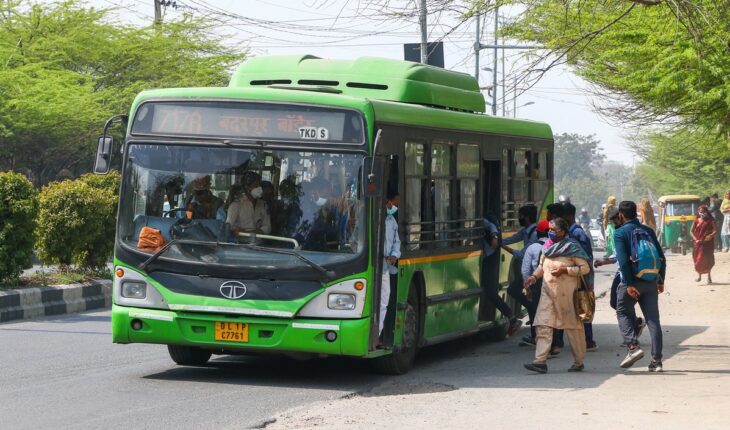
New Delhi:..Seeking to overhaul the capital’s ageing public transport infrastructure, the Delhi government has launched a sweeping reform plan to modernise the Delhi Transport Corporation (DTC). The initiative, aimed at making public commuting more efficient, accessible, and commuter-friendly, includes the introduction of smart travel cards, a complete restructuring of bus routes, major upgrades to inter-state bus terminals (ISBTs), and the redesign of bus queue shelters (BQSs) with modern amenities.
The roadmap was presented during a high-level review meeting chaired by Chief Minister Rekha Gupta on Tuesday, where she emphasised the government’s resolve to transform DTC into a world-class transport service with support from Prime Minister Narendra Modi.
“With the guidance and support of Prime Minister Narendra Modi, we are determined to equip Delhi with a public transport system that meets international standards,” CM Gupta said, addressing senior officials including Transport Minister Dr Pankaj Singh, Chief Secretary Dharmendra Kumar, and Transport Commissioner Niharika Rai.
The Chief Minister pointed out that DTC has been running at a cumulative loss of ₹60,000 crore due to “years of mismanagement,” but assured that the corporation would be “revitalised and transformed into a financially and operationally robust service.”
Highlighting the need for integrated transport solutions, Gupta announced the rollout of a unified smart travel card to enable seamless travel across DTC buses, the Delhi Metro, and the upcoming Regional Rapid Transit System (RRTS).
“A special Pink Card will also be introduced for women and transgender commuters, allowing them free travel in DTC buses. We’re in advanced discussions with banks to ensure a smooth, secure rollout of these cards,” she said.
Currently, Delhi’s public transport fleet includes 660 small electric buses, 1,800 large electric buses, and 1,800 CNG buses, forming a 4,800-strong electric fleet. However, many of these vehicles continue to operate on outdated or inefficient routes.
To address this, the government has partnered with IIT Delhi to develop a new citywide route plan aimed at improving last-mile connectivity and better integration with the Metro network. A pilot project will first be launched in Yamuna Vihar before citywide implementation.
“The new route system will prioritise underserved areas and reduce travel time for daily commuters,” said Transport Commissioner Niharika Rai.
In another major announcement, CM Gupta said all of Delhi’s 4,627 bus queue shelters would be revamped to meet modern standards. Currently, only 2,021 BQSs are functional.
“These redesigned shelters will include LED lighting, real-time arrival displays, solar power support, digital information boards, and weather-resistant features,” the Chief Minister said, adding that the project would be implemented through a public-private partnership (PPP) model.
The overhaul plan also covers Delhi’s key inter-state bus terminals—Kashmere Gate, Anand Vihar, and Sarai Kale Khan—which will be transformed into “airport-like transit hubs” with modern infrastructure, passenger amenities, safety features, and accessibility standards.
“These ISBTs will serve as model hubs for intercity travel, reflecting the new face of Delhi’s transport ecosystem,” said Transport Minister Dr Pankaj Singh.
Reaffirming the government’s long-term vision, Gupta said, “Our goal is not just to upgrade DTC, but to reimagine how Delhi travels. We want our public transport to be a source of pride, safety, and convenience for every citizen.”
The ambitious reforms mark a decisive step toward making Delhi a leader in smart, inclusive, and sustainable urban mobility.