





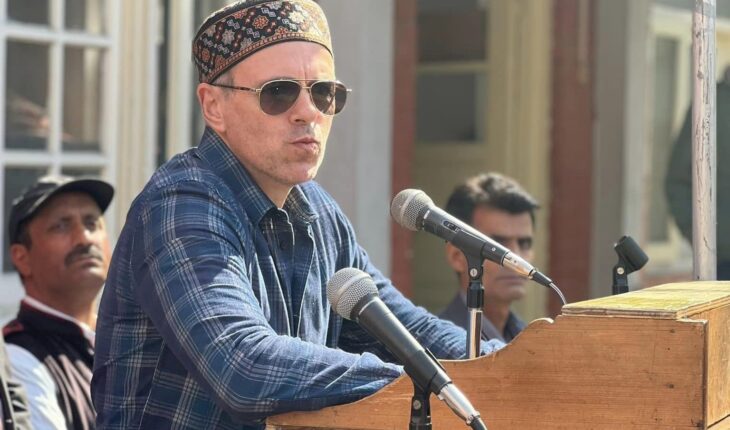
Former Jammu and Kashmir Chief Minister Omar Abdullah said on Sunday that democracy in India ends where J&K begins.
Addressing During a zonal workers’ convention at Tikri in Jammu’s Udhampur district, Omar lamented the absence of elections in Jammu and Kashmir. He highlighted the discrepancy between the democratic process witnessed in other states and the lack thereof in J&K, stating, “We can only witness the spectacle in other states, not here. Democracy ends where J&K begins.”
Abdullah criticized the actions of central government, suggesting a deliberate suppression of democratic institutions within Jammu and Kashmir. He expressed dismay over the union government’s reluctance to involve locals in decisions affecting the region.
“They not only disdain the idea of an assembly but also disregard panchayats and ULBs. It wouldn’t be surprising if they dismantle DDC councils too,” Omar said. “What fault lies with the people of Jammu and Kashmir that they’re denied their democratic rights, even the chance to elect their assembly?”
Abdullah further questioned the government’s narrative regarding Article 370, pointing out the lack of tangible benefits resulting from its revocation for the people of J&K. He highlighted the advantages the article had provided, including land rights and access to free education up to university level, particularly benefiting the marginalized sections of society.
“These individuals speak incessantly about the negatives of Article 370, yet its revocation brought no substantial change for the people of J&K,” Omar said.
“Contrarily, Article 370 safeguarded our people’s land rights and facilitated free education, benefiting numerous, including the landless, poor, and workers, regardless of their religious or regional affiliations. Its abrogation, however, has led to the people’s suffering,” he added.