





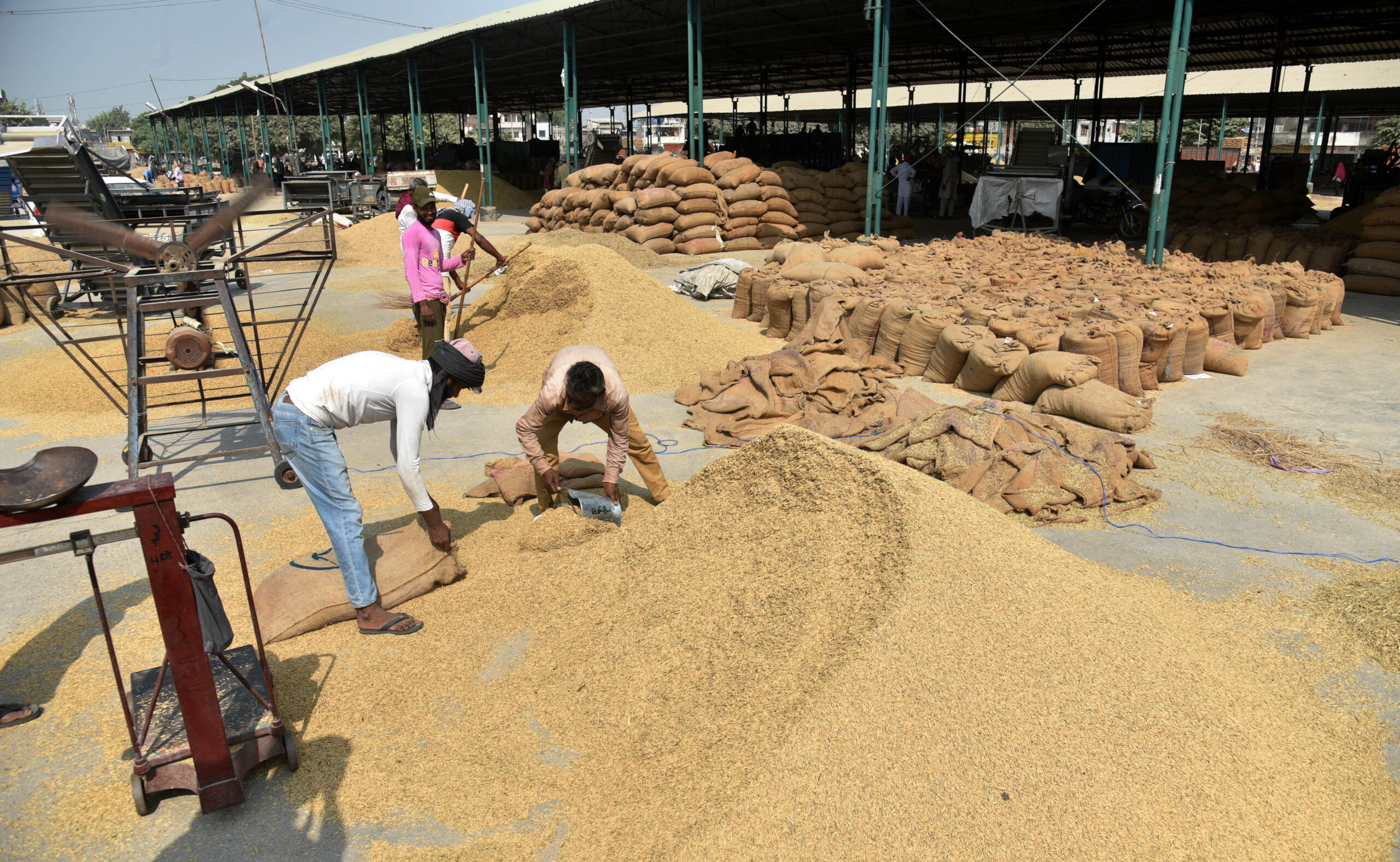
CHANDIGARH: In a significant relief for thousands of paddy growers, the Haryana government announced on Friday that the procurement of kharif paddy for the 2025-26 marketing season (KMS) will commence on September 22, two weeks ahead of the originally scheduled date of October 1.
The decision, formalized through a memo from the Food, Civil Supplies and Consumer Affairs Department, comes in direct response to mounting pressure from farmer unions, who had staged widespread protests citing early crop maturation due to erratic weather and fears of financial losses from delayed sales.

The official memo, issued by Joint Director (Procurement) Vipan Kumar states that the state government has revised the procurement timeline to align with the Kharif Marketing Season 2025-26. “It is to inform you that the State Government has decided the procurement period of paddy in state which will now start from September 22 instead of October during KMS 2025-26,” the document reads.
Haryana Chief Minister Nayab Singh Saini, addressing the media in Panchkula, emphasized the government’s commitment to farmer welfare. “The state government is committed to safeguarding the interests of farmers. In this direction, instead of October 1, the government procurement of paddy in the state will now begin from September 22, 2025,” Saini said. He also announced extensions to related timelines, including the rice delivery period for millers until June 30, 2026, along with bonuses and waivers on holding charges to ease operational burdens.
This move echoes similar government responses in previous years, where farmer agitations prompted swift adjustments to procurement schedules. In 2024, for instance, procurement was advanced to September 27 following protests over weather-induced early harvests and logistical delays. Likewise, in 2021 and 2020, the Centre and state governments relented to union demands amid large-scale demonstrations, starting operations days or weeks ahead of schedule to prevent market gluts and distress sales below the Minimum Support Price (MSP).
The decision arrives against a backdrop of escalating unrest from farmer organizations, who have accused the government of ignoring ground realities. Under the banner of the Bharatiya Kisan Union (BKU) Sir Chhotu Ram, farmers had urged the state to begin procurement as early as September 15, “Our crops are ready, but without procurement, we’re forced to sell to private traders at throwaway prices. This isn’t just about dates—it’s about survival,” said Subhash Chaudhary, a BKU leader from Karnal, during a recent sit-in at a local grain market.
Protests peaked earlier this week, with unions blocking highways and locking market committee offices in Thanesar and Kaithal. The Samyukt Kisan Morcha (SKM), a coalition of over 40 farmer groups, issued a statewide call for demonstrations outside BJP leaders’ residences, reviving memories of the 2020-21 farm law agitations that originated in Haryana and Punjab. “The government’s delays are deliberate, pushing us into debt. We’ve harvested early-maturing varieties, but without MSP procurement, we’re at the mercy of arhtiyas (commission agents) and millers,” SKM convenor Jagmohan Singh said, highlighting concerns over high moisture content norms that often disqualify early-arriving produce.
In recent media reports, farmer leaders pointed to a glut in mandis, where unprocured paddy was rotting amid rains, exacerbating losses estimated at ₹500-700 per quintal below MSP. The Haryana Rice Millers and Dealers Association joined the fray, demanding revisions to custom-milled rice (CMR) policies and higher milling charges—from ₹10 to ₹100 per quintal—to cover rising costs of electricity and labor. These grievances have compounded longstanding issues, including the Centre’s push for crop diversification away from water-intensive paddy, which unions view as a threat to MSP guarantees.
Haryana, a major paddy-producing state contributing around 40-50 lakh metric tonnes annually to the Central pool, procures through agencies like FCI, HAFED, and the Haryana State Warehousing Corporation. The MSP for common paddy stands at ₹2,369 per quintal this season—a 74% increase since 2014, as per CM Saini—while Grade A fetches ₹2,389. The state’s target for 2025-26 is approximately 55-60 lakh metric tonnes, with procurement centers operational across 367 mandis.
Opposition leaders, including former Chief Minister Bhupinder Singh Hooda of the Congress, have criticized the BJP-JJP government for “misleading farmers” on MSP continuity.
As mandis gear up for the revised start, officials have assured seamless operations, including help desks for e-registration and moisture testing.