





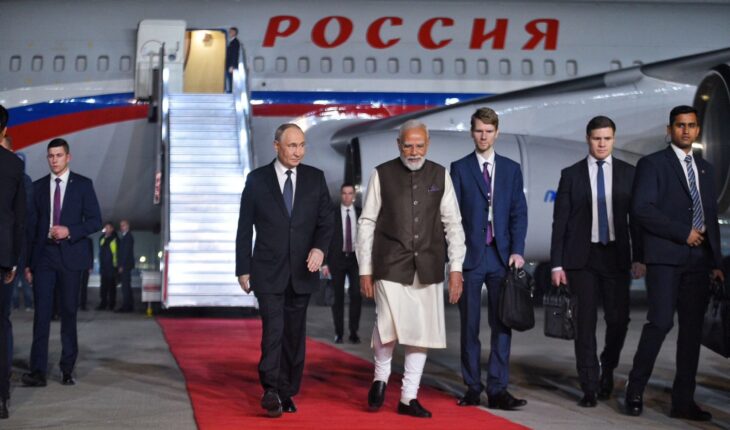
The ongoing visit of the Russian President Vladimir Putin to New Delhi is likely to be claimed as a substitute for the American support, though falsely, perhaps a narrative for compensating for the sudden decline in the personal relations between the US President, Donald Trump.
An informed official of the Indian foreign office appeared to be more concerned about the false projection in the Indian media that India may find a substitute for the “arrogance of Trump” during the summit. In fact, few in New Delhi are ready to subscribe to these narratives, perhaps, being only motivated for carving out a macho-image of Modi. It may appear to be more acceptable among the political buffoons dominating the contemporary political ruling elite, but the informed sources in New Delhi are just amused by the story tellers in the Indian media, which has now few analysts basing their comments only on facts
It is being stated that during this visit Putin offered deeper collaboration with India in focusing on energy development and in continuing defence ties, but the new factors have emerged in the non-conventional warfare in the region, especially after the Operation Sindoor. It cannot be denied that the Chinese software and strategic artificial intelligence based information had given an initial edge to Pakistan. It had forced India to put her ultimate missile systems to force a ceasefire.
It is not being denied that the warmth between the US under Trump and India has suffered a setback, if not total eclipse, in recent months, while in private communications both sides appreciate the need to upgrade the ties between the two democracies.
In recent months, India has substantially conceded to the US pressure by buying crude oil from some American companies, but. India is not prepared to totally stop oil imports from Russia, which she has been continuing despite sanctions.
Also, the Indian defence systems have been on the Russian platforms, but the recent collaboration between Moscow and Beijing in strategic software has caused concerns in New Delhi. In other words, Russian weapons in the coming years might be using the state-of-the art software of China, thus weakening her defence preparedness against her northern neighbour, which has refused to turn India -Tibet border into an international border; once suggested by the successor of Mao Zedong, Deng Xiaoping, but could not be done due to the political uncertainty during the post Rajiv Gandhi period.
In this background, the Indian negotiators might face a piquant situation in adopting the new generation weapons from Russia unless Moscow clarifies its defence collaboration with China.
Russians Need Cash
Admittedly, the American sanctions have caused a cash crisis in the Russian economy. According to some western sources, the GDP of Texas, just a state of the US Federation, was approximately 2.2 trillion USD in 2024, while Russia’s was approximately $2.1 to $2.5 trillion in 2025, making them comparable in size, but with Texas’s economy often ranked slightly higher in nominal terms.
Earlier,In 2022, the Texas GDP was 2.4 trillion USD, while Russia’s was around 2.29 trillion. It means that the conflict with Ukraine has cost a lot to the Russian economy.
Meanwhile, a large number of Russian oligarchs have reportedly decamped with billions of US dollars to escape to safe destinations in cities like London in Europe and in Dubai and Qatar in West Asia. Earlier, they were considered suspects for collaborating with Moscow against Ukraine, but their quiet existence has evolved an undefined bond with the West. It has further eroded their remittances to Russia.
In this backdrop, it is not surprising that Moscow is facing a cash-crunch. Even rupee trade with New Delhi is expected to facilitate the daily needs of the Russian people depending upon imports of tea and other food and utility items from India.
It is expected that during his two- day visit to New Delhi would be offering a vast range of defence equipment and energy products. In other words, he would be pitching for more sales of Russian oil, missile systems and fighter jets in a bid to restore energy and defence ties believed to be hit by U.S. pressure.
During the current financial year, India’s crude imports are set to hit a three-year low this month.
Putin, who is being accompanied by his defence minister, Andrei Belousov, and a wide-ranging delegation from business and industry, might be signing a long -term cooperation with India.
A Challenge to Diplomacy
It is widely believed that Putin’s visit has drawn worldwide attention. In New Delhi, however, it is stated that the mandarins of the North Block, which houses three key ministries, defence, foreign office and the office of the prime minister, would be able to negotiate with dignity this time, especially with the weakening of the grip of the so-called think tanks being run by some private business corporation. They could reach the heart of the Indian state by quietly funding the present ruling alliance, but their role was exposed during the Raisina discussions, when the Russian foreign minister, Sergey Lavrov, asked its director, a former babu in the Madhya Pradesh government, to get proper briefing from your American mentor before asking any questions. The outfit is reportedly having close ties with the family of the foreign minister S. Jaishankar.
It is hoped that despite the inability of the political leadership to give a clear direction, the genius of Indian diplomacy would steer the country’s interests in the contemporary trade dynamics with both Russia and the US.
It may be recalled that during the brief tenure of the Janata Party regime in 1977, Indian diplomacy was at its zenith under the then Minister for External Affairs,Atal Bihari Vajpayee, who later became the prime minister. It is hoped that Modi would finally get a seasoned political leader as a replacement for Jaishankar, a former bureaucrat. Also, he will get rid of the dead political woods in his cabinet.
In spite of the prevailing inadequacies at the apex, theknowledgeable sections in New Delhi are optimistic about the visit. They are keenly observing the outcome, whether India would succumb to the US pressure by bringing down her crude oil imports from Russia or assert her autonomy, if not her sovereignty, by resisting the American pressure. Admittedly, it is a hard and challenging task for Indian diplomacy, but India has a vast resources of talented people in her foreign office. It is hoped that they would successfully navigate pressure from Trump. The answer is not straightforward – laced in geopolitical, economic and diplomatic issues.
India is in need of new fighters seeking cooperation in the energy field especially for setting up new nuclear power plants. It is hoped that Putin and his team would agree to a joint development of the fifth-generation fighter jet and a multi-role transport aircraft. Russians may agree to offer as many as 25 nuclear reactors to meet the pier needs of India. It may be noted that already a 1,000-megawatt reactor is operating at the Russian-built Kudankulam power station in Tamil Nadu with a second due to come onstream soon.
The implications of this visit are going to be having an impact on geopolitics.
Gopal Misra has been associated with national and international media. His books on journalism and geo-politics have been well-appreciated. Views are personal.