





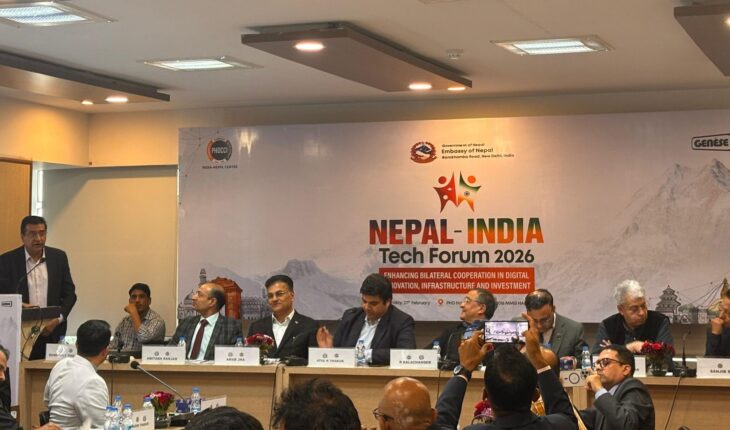
New Delhi: Indian IT majors have been urged to explore Nepal as a high-potential digital investment destination, as policymakers and industry leaders from both countries gathered at the Nepal–India Tech Forum 2026 in the national capital on Friday.
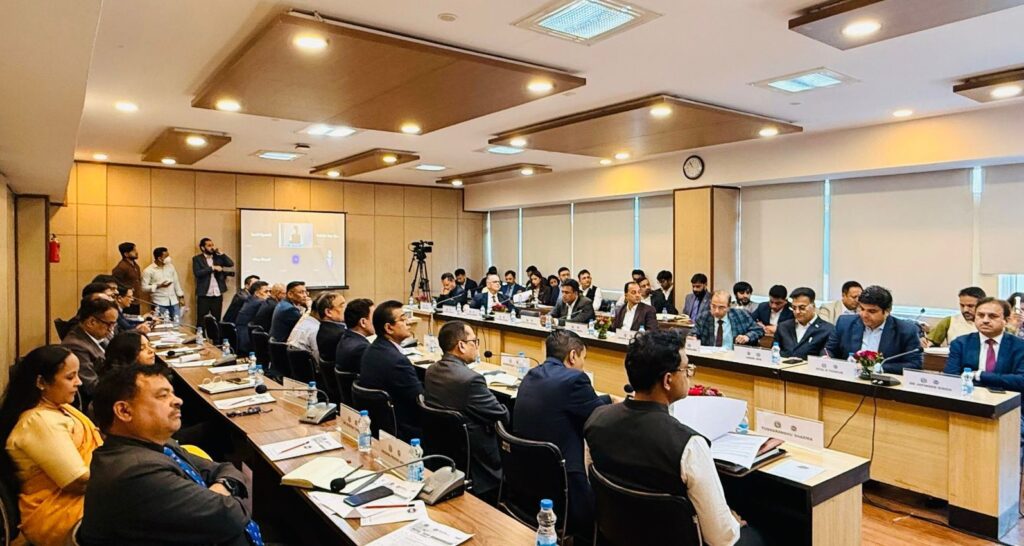
Organised by the PHD Chamber of Commerce and Industry (PHDCCI) under the aegis of its India–Nepal Centre, in association with the Embassy of Nepal in India and Genese Solution, the forum brought together a distinguished gathering of policymakers, diplomats, business leaders, and technology experts to advance dialogue on deepening Nepal–India ties in the digital and technology space.
Delivering the keynote address as Chief Guest, Dr Shankar Prasad Sharma, Ambassador of Nepal to India, described technology as an important frontier where an aspirational Nepal and a rising India can further collaborate and deepen bilateral ties.
Calling for a “tech upgrade” in the relationship, he invited Indian IT giants to look toward Nepal, citing its strong credentials as a promising investment destination.
“Nepal’s digital journey has evolved significantly — from its first IT Policy in 2000 to the National AI Policy 2025 and an IT Decade Vision,” he said.
Ambassador Sharma highlighted Nepal’s efforts in building Digital Public Infrastructure, including data centres, digital payment systems, and citizen service platforms, developed with support from India, the Asian Development Bank (ADB), and the World Bank. He noted that Nepal produces over 10,000 ICT graduates annually, though talent retention remains a challenge as many professionals move abroad within a few years.
He outlined the government’s FASG Framework — covering Foundation, Access, Skills, and Growth — as a structured roadmap for inclusive digital transformation, with AI Excellence Centres planned across four provinces. While policy frameworks are in place, he stressed that implementation and stronger private-sector collaboration remain critical.
Pointing to Indian firms such as Infosys already operating in Nepal’s banking sector, Sharma identified opportunities in cloud computing, fintech, cybersecurity, and artificial intelligence, asserting that technology could become a defining pillar of Nepal–India partnership.
Munu Mahawar, Additional Secretary (North) at India’s Ministry of External Affairs, joined as Guest of Honour and reaffirmed India’s commitment to fostering deeper tech-driven cooperation with Nepal.
He praised the initiatives of the PHDCCI India–Nepal Centre and the Embassy of Nepal in India for strengthening economic engagement. Reflecting on cross-border infrastructure developments such as Integrated Check Posts (ICPs), petroleum pipelines, improved transit routes, and trade facilitation measures, Mahawar noted their positive multiplier effects on both economies.
“Technology sits at the heart of deepening Nepal–India cooperation,” he said, emphasizing India’s priority to share technological capabilities with neighbouring countries in addressing Global South challenges through scalable solutions.
Mahawar highlighted that the UPI–Nepal payment integration, operational since 2024, has processed over one million transactions, with peer-to-peer remittance functionality nearing launch. He also pointed to Nepalese participation in an IIT-based startup programme, where nine startups received investment and incubation offers.
Digital solutions, he added, are now being layered across trade facilitation, railways, agriculture, health, and energy sectors, with technology embedded in nearly every bilateral Memorandum of Understanding. Deep educational exchanges, he noted, are building shared human capital for long-term digital collaboration.
Manjeev Singh Puri, Chair of the India–Nepal Centre at PHDCCI and India’s former Ambassador to Nepal, observed that India’s rising global stature in artificial intelligence and advanced technologies presents a significant opportunity for Nepal.
He noted that Nepalis hold a unique advantage due to deep cultural familiarity and growing representation in India’s technology hubs such as Bengaluru and Hyderabad. In the AI era, he said, success depends less on scale and more on language, data, and innovation — areas where Nepal can compete effectively.
Shekhar Golchha, former President of the Federation of Nepalese Chambers of Commerce and Industry (FNCCI) and Chairman and Managing Director of the Golchha Group, highlighted Nepal’s macroeconomic stability, citing foreign reserves covering nearly 20 months of imports, inflation between 3–4 per cent, interest rates at 5.2 per cent, and a stable currency.
However, he acknowledged that insufficient job creation continues to drive skilled youth abroad. Technology, he said, presents a transformational opportunity to reverse this trend.
With Nepal on track to become power-surplus through renewable hydropower, Golchha pointed to the country’s natural advantages for energy-efficient data centre infrastructure. He stated that Nepal is well-positioned to evolve into a digital economy that not only consumes technology but also creates and hosts it.
The private sector, he noted, has set an ambitious target of reaching a $100 billion economy by 2030 through good governance, structural reform, and deeper India–Nepal collaboration. With 70 per cent of Nepal’s trade linked to India, he described the partnership as indispensable.
In a symbolic proposal, Golchha suggested establishing an IIT campus in Kathmandu, arguing that such an institution would represent true 21st-century integration built on innovation and intellectual collaboration.
Addressing delegates virtually, Sushil Gyewali, CEO of Investment Board Nepal (IBN), extended an open invitation to technology operators, AI investors, Indian IT majors, cloud providers, and data centre leaders to form enduring partnerships.
“Powered by renewable hydropower, Nepal offers a unique advantage as a clean-energy digital infrastructure destination in South Asia,” he said, outlining a vision to shift from migration-driven growth to innovation-driven employment.
Anand Jha, Vice President (Head of Government Engagement: India & South Asia) at Visa Inc., highlighted Visa’s expanding presence in Nepal, including workshops conducted across all seven provinces with global experts in AI, cybersecurity, and e-commerce.
He proposed three priorities: establishing a regulator-led cross-border payment corridor between Nepal Rastra Bank (NRB) and the Reserve Bank of India (RBI); adapting India’s Digital Public Infrastructure model to Nepal’s scale; and digitising small merchants and SMEs, particularly in tourist hubs that remain largely cash-based.
“A POS device costs just $8. This is an awareness gap, not a technology gap,” he remarked.
The forum featured a detailed presentation by Anjani Phuyal, CEO of Genese Solution, and an entrepreneurial account by Dipesh Karki, Co-Founder and CTO of Lenden Club.
Dr Jatinder Singh, Deputy Secretary General of PHDCCI, delivered the welcome address, while Atul K Thakur, Senior Secretary of the India–Nepal Centre, moderated the roundtable discussion.
Speakers included Amar Jha, Amitabh Ranjan, Satya Narayanan R, R Balachander, Anukool Bhatnagar, Dushyant Thakor, Shivam Shekhawat, Poshak Poudel, Sanjib Subba, Vineet Nahata, Bikalp Raj Pokharel, Asish Thakur, Shashvat Singh, Atul Koirala, Dr Kazem Samandari, and Dr Bhuvnesh Shrivastava, among others.
Notable dignitaries present included Dr Surendra Thapa, Deputy Chief of Mission at the Embassy of Nepal in India; Tara Nath Adhikari, Minister (Economic); Rabindra Jung Thapa, Counsellor (Economic); and Tusharanshu Sharma, Deputy Secretary (Northern Division: Nepal-Economic), Ministry of External Affairs, Government of India.
The consensus emerging from the forum was clear: digital collaboration is poised to redefine Nepal–India relations beyond traditional trade and cultural ties. With policy frameworks in place, renewable energy advantages, and expanding cross-border digital integration, speakers positioned technology as a central pillar for shared prosperity and long-term economic transformation.