





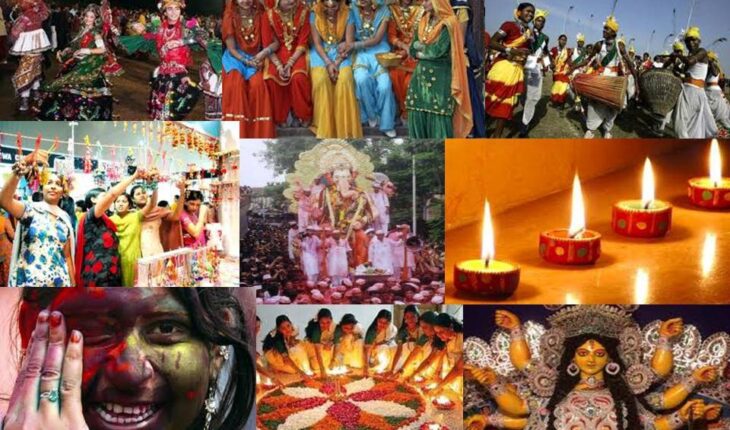
Indians are known for their vibrant celebrations, making India famously recognized as the “land of festivals.” The country hosts a rich tapestry of festivals celebrated throughout the calendar year, each bringing its distinctive customs and traditions to life. The festive season kicks off with Makar Sankranti in January, signalling the transition to longer days, and is followed by a series of joyous occasions including the exuberant colours of Holi, the harvest festivities of Vaisakhi, the heartfelt bonds celebrated during Raksha Bandhan, the grandeur of Ganesh Chaturthi, the triumph of good over evil during Dussehra, the dazzling lights of Diwali, the reverent observances of Chhath, and concludes with the global celebration of Christmas in December.
These festivals serve as a rejuvenating elixir for the soul, infusing communities with an infectious energy and a spirit of unity. During these times, an atmosphere filled with faith, enthusiasm, and sheer joy pervades the nation, encouraging people to come together in celebration. Beyond their cultural significance, these festivals play a crucial role in bolstering the economy by generating employment opportunities and enhancing economic activity.
Annually, the financial transactions during these festive periods reach astonishing figures, amounting to millions of crores of rupees. This year, both online and offline sales platforms are projected to generate an impressive 6 lakh crore rupees worth of business. Of this total, the turnover from offline platforms is anticipated to be around Rs 4.80 lakh crore, while online platforms are expected to contribute approximately Rs 1.20 lakh crore. This staggering amount constitutes about 3.2% of India’s real gross domestic product (GDP), showcasing the significant impact of festive spending on the economy.
Major e-commerce giants, such as Flipkart and Amazon, have strategically leveraged the festive season, particularly in light of recent reforms to the Goods and Services Tax (GST). Some companies have even initiated promotional discounts as early as September 22nd to capitalize on the shopping fervour. Research by Datum Intelligence suggests that the revised, consumer-friendly GST rates could potentially amplify festive sales this year by 27%, aiming for a target of ₹1.20 lakh crore by 2025. The restructuring of tax slabs has favourably reduced prices on a wide range of essential products, which is expected to boost sales by 15-20%. Under the new GST paradigm, there are now only two tax slabs: 5% and 18%, with several rates eliminated, resulting in consumer savings that may reach as high as 10%. Products such as televisions, air conditioners, electronic appliances, and other consumer durables are particularly well-positioned to benefit from these changes, indicating that smartphones and televisions will likely emerge as the most sought-after items in the e-commerce landscape this year.
An additional increase in sales is anticipated for laptops, desktops, gaming consoles, digital cameras, smart home devices, and two-wheelers as well.
Furthermore, a recent report from Datum Intelligence indicates that urban consumer spending has experienced a positive upswing for the first time in three years. In July alone, an impressive 37.6% of consumers reported an increase in non-essential spending. Rural consumers have exhibited even greater enthusiasm, showcasing a 54.7% rise in spending, marking the highest growth in the past two years. These trends indicate a rise in incomes over recent months, contributing to increased savings and spending patterns. Consequently, this has led to a robust surge in economic activity in both urban and rural sectors, fostering an environment that continuously promotes inclusive growth nationwide.
The Confederation of All India Traders (CAIT) recently conducted a comprehensive survey, revealing that the estimated online business during the festive season, spanning Raksha Bandhan, Ganesh Puja, Navratri, and Diwali, is projected to reach a staggering ₹4.80 lakh crore this year. This figure marks a significant increase from approximately ₹3.5 lakh crore recorded last year, indicating a robust 27% growth in offline business compared to the previous year. Notably, spending during Raksha Bandhan has surged by an impressive 75% compared to last year, leading analysts to believe that the overall business volume may surpass current estimates.
In India, festivals resonate deeply with the populace, engaging around 700 million consumers who fully immerse themselves in the shopping experience. Festivals are not merely occasions; they embody the faith, joy, enthusiasm, and cultural richness of the society. This vibrant spirit fuels participation from all segments of society, including those from economically disadvantaged backgrounds, ensuring that everyone partakes in some form of shopping during these auspicious times.
During the grand celebration of Diwali, it is customary for families to purchase new garments for themselves and to offer them to the Goddess Lakshmi. The preparations extend beyond personal attire, encompassing clothing for deities, decorative elements for the home, thorough cleaning, and even repainting in honour of the festivities. The wide array of items purchased during this time reflects the diverse cultural practices and preferences, resulting in heightened demand for a variety of goods. Among the key purchases associated with the festive season are gift items, an assortment of sweets and dry fruits, electronic gadgets including mobile phones and laptops, vehicles like cars and scooters, clothing (both traditional and contemporary), gold and silver jewellery, utensils made of steel, copper, and brass, as well as decorations such as earthen lamps, toys, flowers, and fruits.
This significant surge in consumer behaviour during festivals not only boosts the demand but also the supply chain of numerous products. For instance, during Diwali, a flurry of activity revolves around home improvement. People indulge in cleaning and refurbishing their living spaces, leading to increased demand for hardware supplies, paints, dyes, and construction materials such as cement, wood, and plywood. Furthermore, large and extravagant pandals are constructed, with vibrant cultural programs being organized during the Dussehra and Ganpati festivals, showcasing the rich traditions and artistry of Indian culture.
The festive spirit also attracts a significant influx of foreign tourists, with a noteworthy 67% rise compared to last year during Diwali. Cities like Kolkata and other eastern states become hotspots for these tourists during Dussehra, as Indian festivals have long captivated the interest and curiosity of visitors from around the globe. Beyond tourism, these festivals generate substantial employment opportunities and increase the demand for services in various fields, including hospitality, event management, and transportation services such as cabs and logistics.
In summary, the significance of festivals in India transcends mere celebration; they are an integral part of the social fabric, imbued with deep-seated values of faith, enthusiasm, love, and harmony. These occasions not only bolster the economy through increased spending and consumer activity but also create opportunities for countless individuals, thereby reinforcing the nation’s economic structure and cultural heritage.
Satish Singh is a Senior Columnist based in Mumbai, and the opinions expressed in the article are personal.