






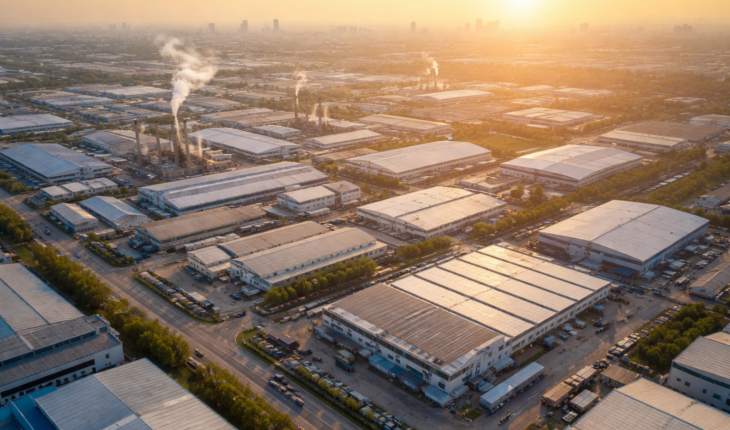
The industrial sector in Haryana is facing a slowdown with the number squeezing effect. A survey conducted in this regard by The Financial World correspondent observed that the industry in the state has witnessed fast shrinking investments, and the large number of manufacturing units migrated their businesses to other states, mainly due to a combination of rising operating costs, government policy and environmental restrictions. As of late 2025 and early 2026, the state is seeing a steady decline in the number of operational factories, particularly in key hubs like Gurugram and Faridabad. The survey revealed that the primary reasons for the industrial slowdown in Haryana include high cost of doing business, a sharp hike in electricity tariffs by the Haryana Electricity Regulatory Commission (HERC) has increased bills by nearly 50% for many industrial units, always Rates in Haryana always higher than neighboring states like Uttar Pradesh, Punjab and Rajasthan making difficult to eun industry in the state.
Among other reasons why industry entrepreneurs find running industry in the state uneconomical is due to high cost of land and operational overheads, including wages, making it difficult for MSMEs (Micro, Small, and Medium Enterprises) to survive. Survey revealed that despite availability of unutilized industrial land, with thousands of plots lying vacant the costs of land infrastructure are too high. Environmental restrictions norms due to ban on diesel generator sets, particularly in the National Capital Region (NCR) part of Haryana, have included bans on diesel generator sets in another reason posing a major disadvantage for industries dependent on stable power, leading to operational shutdowns. Policy and Regulatory Issues are other reasons for the slowdown of industry in Haryana as compared to other states. Labor Job Reservation Law policy, mandating 75% reservation of private-sector jobs for local youths for jobs under rupees 30,000 per month creates hesitation among investors due to increased labor management difficulties.
Many industry investors blame weak policy Implementation a major reason why either industry is being closed down or migrating to other states, while the state has introduced business-friendly policies, their implementation has been reported unfavorable due to delays in approvals causing investor distrust. They said procedural Issues with land acquisition, high augmentation charges and complex regulatory frameworks continue to be major problems for the investors, especially in industrial areas. Study also revealed that external economic factors are other reasons for decline in industry in the state as well as exports. The textile and garment sector, a major employer in Haryana, suffered a huge decline in US orders and the impact of tariffs, resulting in a large number of factories either shutdowns their business in the textile sector or shifted to alternate business after suffering cancelation of huge export orders. It has been observed that due to the aforementioned factors, numerous manufacturing firms are shifting their operations to other states that offer lower costs and more incentives.
In key industrial areas like Gurugram, Faridabad and other industrial belts in Haryana, there are complaints about poor infrastructure, including bad roads and inadequate services, which have created discontent among factory owners. When discussed with industry entrepreneurs, there was a stated need for better incentives in A-category developed areas, rather than only in C and D blocks areas. However, Haryana still possesses inherent logistical advantages due to its proximity to Delhi, whereas these factors are causing significant distress to the state’s industrial sector, entrepreneurs said. It cannot be denied Haryana, formerly regarded as one of North India’s robust industrial regions, is experiencing a gradual decrease in the count of registered factories. Recent official statistics reveal a continual decline over the past few years, sparking worries about investment, job opportunities and the long-term industrial viability of the state. However, in contrast, neighboring Punjab has successfully maintained its industrial presence,
According to information, Haryana had 10,389 registered factories in 2023-24, a decrease from 10,603 the previous year. This continues a multi-year drop that began in 2018-19, when the state had 11,835 factories. Over the next five years, the total number of factories reduced by around 1,446 – a loss of roughly 12.2% of the industrial base. According to available data in 2018-19 there were 11,835 registered factories in the state, in 2019-20 declined to 11,200. RBI data shows annual decline as 10,900 registered factories in 2020-21, continued decline to 10,700 in 2021-22, 10,603 in 2022-23, 10,389 in 2023-24 witnessing a total over 12.2% drop so far. A declining factory count reflects deeper challenges. Key industries targeted for incentives in Haryana include Auto, Agro, Textiles, Electronics, Defence, Pharma, Chemicals and Energy sectors. Information reveals that Punjab maintained a higher number of factories and even added units over the last five years. Whereas in contrast, Haryana lost over 1,400 units during the same period.