





Governor Ashim Kumar Ghosh outlines roadmap for regularising 858 colonies, metro expansion, affordable housing, crime crackdown and Vision–2047 goal of a $1 trillion economy; CM Nayab Singh Saini steers key housing reform amid political sparring
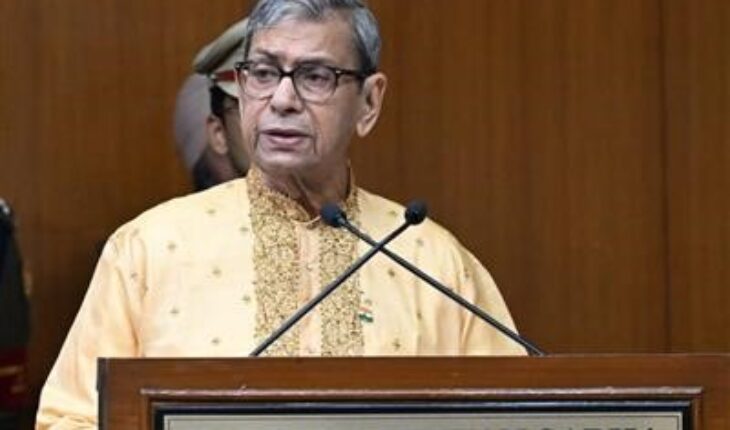
CHANDIGARH: The Budget Session of the Haryana Vidhan Sabha commenced on Friday with an expansive address by Governor Ashim Kumar Ghosh, who laid out a comprehensive roadmap focused on inclusive urban growth, transparent governance and citizen-centric services.
The proceedings of the Haryana budget session commenced with the playing of Vande Mataram. The opening day also witnessed sharp political exchanges and key administrative decisions, setting the tone for the session ahead.
In his address, the Governor underscored the government’s commitment to regularising 858 unauthorized colonies spread across 11,503 acres within municipal limits. Development works worth ₹723.18 crore have already been approved to upgrade civic infrastructure in these colonies, a move expected to provide legal recognition and essential amenities to lakhs of families.
Highlighting urban mobility, the Governor announced that the extension of the Delhi Metro Red Line from Narela to Kundli has been sanctioned. A budget provision of ₹300 crore has been earmarked for the Gurugram Metro Rail project, with construction of its 11-km first phase underway. Since 2014, metro lines spanning 34.76 km have been operationalised with an investment of ₹5,500 crore.
Affordable housing remains a central pillar of the state’s development agenda. Under the Deen Dayal Jan Awas Yojana, 127 licences have been issued this year across 1,100 acres, enabling 16,797 affordable plots. Additionally, 11,525 dwelling units have been approved under the Affordable Group Housing scheme. In a significant administrative reform, Chief Minister Nayab Singh Saini presented and secured passage of a government resolution merging the Housing Board Haryana with the Haryana Shehri Vikas Pradhikaran (HSVP) to streamline urban planning and housing delivery.
Women empowerment featured prominently in the Governor’s speech. He informed the House that over 1,06,325 women have become “Lakhpati Didis,” reflecting growing economic self-reliance. Under the Drone Didi Yojana, 33 women have been trained and training of 15 more is underway, with plans to skill 1,350 additional candidates through Drone Imaging and Information Services of Haryana Limited. Self-Help Groups have been strengthened through ‘Sanjha Bazaars’ and 124 Atal Shramik-Kisan Canteens operated by rural women entrepreneurs.
On law and order, the Governor reported that 426 criminal gangs have been busted and 15 gangsters extradited or deported, leading to a 40 percent reduction in extortion cases. Dial-112 services now record an average response time of 9 minutes and 44 seconds. He also cited a decline in crimes against Scheduled Caste women and a reduction in cases registered under the SC/ST (Prevention of Atrocities) Act.
The address outlined progress in public utilities. Drinking water supply has been ensured in 7,299 villages and 85 towns, while 57 projects under AMRUT 2.0 worth ₹1,727 crore are underway. In the energy sector, investments of ₹4,818 crore since 2020-21 have strengthened transmission infrastructure. An 800 MW ultra-supercritical unit in Yamunanagar, foundation stone laid by Narendra Modi in April 2025, is expected to bolster capacity. The state aims to equip all government buildings with solar energy by December 2027.
Calling for constructive dialogue and consensus-driven policymaking, the Governor said the House must translate the aspirations of the people into tangible outcomes. However, the session began amid political sparring, with the Chief Minister criticising the Congress for allegedly undermining constitutional institutions.